 AD€ - Les Amis de l'Euro


News
BANKNOTES Biannual report about counterfeiting
In the first half of 2009 a total of 413,000 counterfeit euro banknotes were withdrawn from circulation. This is an increase of around 17% on the quantity recovered in the previous six months. The table below indicates the half-yearly trend in the number of counterfeits recovered.
| Period | 2004/1 | 2004/2 | 2005/1 | 2005/2 | 2006/1 | 2006/2 | 2007/1 | 2007/2 | 2008/1 | 2008/2 | 2009/1 |
| Number of counterfeits | 307,000 | 287,000 | 293,000 | 286,000 | 300,000 | 265,000 | 265,000 | 296,000 | 312,000 | 354,000 | 413,000 |
No significant new counterfeit classes [1] were discovered during this reporting period. Thus, the increase in quantity is due entirely to existing counterfeit classes being distributed more widely than before.
The scale of counterfeiting should be compared with the number of genuine euro banknotes in circulation (some 12.5 billion on average in the first half of 2009).
Nevertheless, the Eurosystem – i.e. the European Central Bank (ECB) and the 16 national central banks of the euro area – advises the public to remain alert with regard to the banknotes received in cash transactions. The more familiar one is with the properties and characteristics of genuine banknotes, the easier it will be to detect a counterfeit. Consequently, the Eurosystem is continuing to invest considerable effort in ensuring both that the public are well informed about how to recognise a counterfeit banknote and, for the professional cash-handling community, that banknote-handling and processing machines can reliably identify and withdraw counterfeits from circulation. Genuine banknotes can be easily recognised using the simple “FEEL-LOOK-TILT” test described on the euro pages of the ECB’s website (www.euro.ecb.eu) and the websites of the Eurosystem national central banks.
If in doubt, however, a suspect banknote should be compared directly with one that is known to be genuine. Anyone who suspects that they may have received a counterfeit should contact either the police or – where national practice allows – the relevant national central bank.
The table below provides a breakdown by denomination for the counterfeits withdrawn from circulation in the first half of 2009.
| €5 | €10 | €20 | €50 | €100 | €200 | €500 | |
| Breakdown by denomination | 0.5% | 1% | 48.5% | 34% | 13.5% | 2% | 0.5% |
In the first half of 2009 the most counterfeited banknote was the €20, which accounted for almost half of all counterfeits found. The three mid-range denominations (€20, €50 and €100) together accounted for more than 95% of all counterfeits.
The majority (more than 98%) of counterfeits recovered in the first half of 2009 were found in euro area countries, with only around 1% being found in EU Member States outside the euro area and less than 0.5% being found in other parts of the world.
European Central BankDirectorate Communications
Press and Information Division
Kaiserstrasse 29, D-60311 Frankfurt am Main
Tel.: +49 69 1344 7455, Fax: +49 69 1344 7404
Internet: http://www.ecb.europa.eu
AUSTRIA €100 gold "The crown of a Archduc"
The austrian mint announce the second 100-Euro gold-coin of the series "Crowns of the House of Habsburg".
The coins of the Serie
2008: The Crown of the Holy Roman Empire
2009: The Crown of an Austrian Archduke
2010: The Crown of Saint Stephen (Hungary)
2011: The Crown of Saint Wenceslas (Bohemia)
2012: The Crown of the Austrian Empire
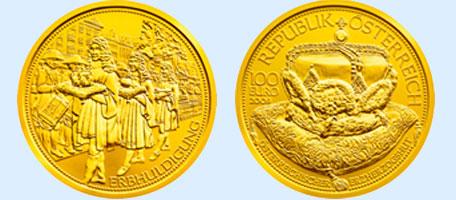
Caracteristics:
| Face Value | 100Euro |
| Date of Issue | 4th of November 2009 |
| Design | H. Andexlinger |
| Alloy | Au 986/1000 |
| Fineweight | 16 g |
| Diameter | 30 mm |
| Mintage | Proof: 30,000 pcs. |
| Price | 462 euros (tax free)
|
ITALY €2 commémorative coin 2009
Italian mint will issue a second commemorative coin this year dedicated to the bicentenary of Louis Braille birth (like belgium). The design is different from what we usually see on italian €2 commemorative coins.
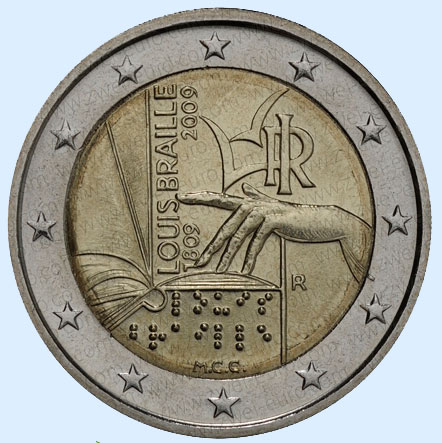
Issue date october
Quantity 2.000.000
Picture source: Zwei euro
CYPRUS Mintage 2009
Contrarily to Slovenia and Malta whitch not mint euro coins for their second year in euro area, Cyprus will mint coins il all value.
BU set: 15.000
1 cent : 19.985.000
2 cent : 985.000
5 cent : 5.985.000
10 cent : 985.000
20 cent : 985.000
50 cent : 985.000
1 euro : 3.985.000
2 euro : 4.985.000
AUSTRIA €10 Richard coeur de lion
The second coin dedicated to the most fabulous histories and legend from Austria celebrate "Richard lion's hearts in Durnstein".
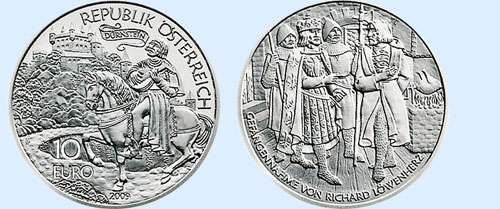
Quantity: 130.000 UNC / 30.000 BU / 40.000 proof
weight: 16 grammes
Metal: silver 925/1000
Diameter: 32 mm
Issue: October